
Overseas arcades and Korea-centric defaults
Reading an overseas arcade in Korean should not move that venue into Korea’s time zone. After launching in Korea, Musecat began global expansion in the second half of 2025 and needed to revisit Korean defaults for addresses, countries and time zones. Allowing foreign-language addresses alone would not make local dates and prices behave correctly.
Publication requirements also needed attention. Applying conditions developed while collecting Korean venues everywhere would demand the same evidence regardless of local collection circumstances. We needed common information requirements with regional conditions represented separately.
Country and time zone from coordinates
A time zone provides the basis for interpreting a venue’s dates and times. Rather than create an overseas-only model, we added explicit country and time-zone values to the existing one. Creation and location edits look them up from coordinates. Addresses guide visitors; coordinates support distance and place checks. Interface language is chosen independently.
For example, correcting a misplaced unpublished draft can also update its country and time zone. A published venue, however, cannot accept a location change that moves it into another country. This prevents an established document from quietly becoming a different country’s venue. Publication is also blocked when location and country disagree.
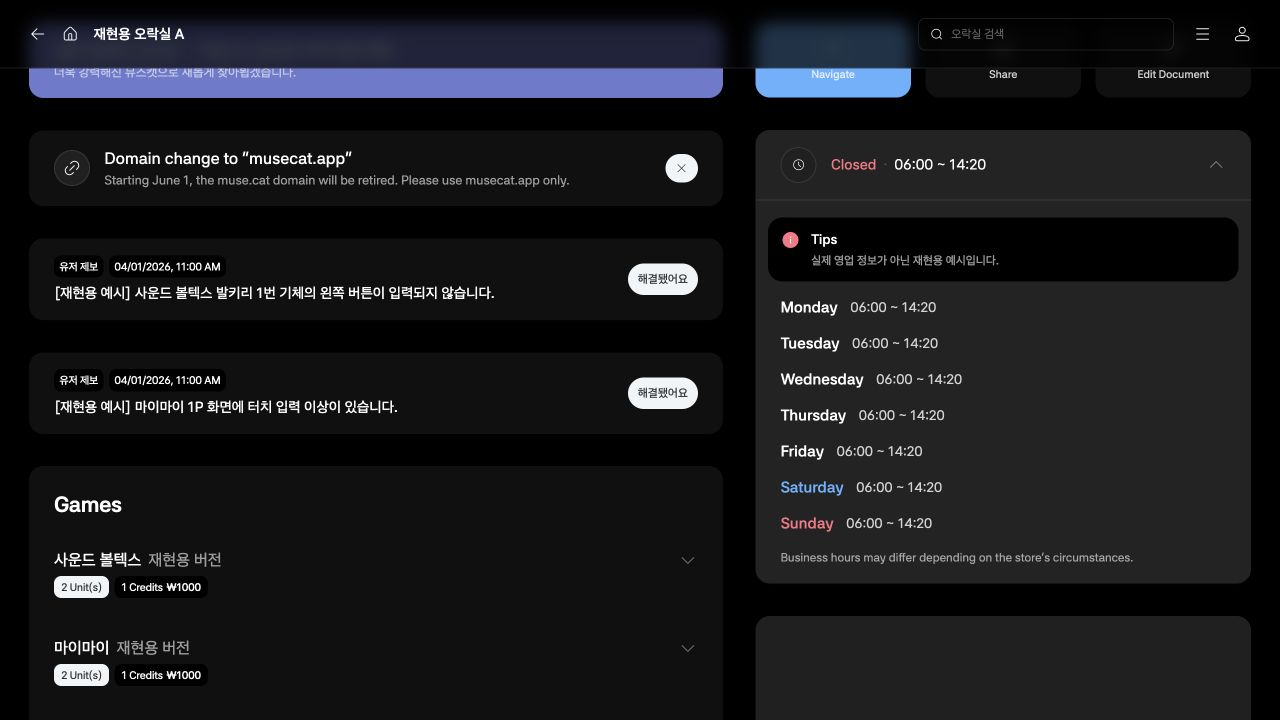
English interface from Delta’s legacy Gamma-Web source dated 2026-04-01, reproduced with sample data. Weekday opening hours are expanded; a few original labels remain Korean.
Regional publication requirements and existing data
Publication retains common requirements for registered games and either SNS information or opening hours. Facility photographs are a separate requirement for Korean arcades. This expresses regional needs without an overseas-only service or duplicated APIs. Country filters in the query API provide country-specific lists and search from the same backend.
Saving time zones for new requests does not fill gaps in existing data. A separate backfill supplies those missing values. It reads coordinates from linked basic information, looks up the time zone and stores it. Keeping this operation separate makes missing venues easier to identify and reprocess.
Interface language and local information
The same arcade now retains its country and time zone whether its page is viewed in Korean, English or Japanese. Country-specific search and overseas registration use one model. Supporting another region can use explicit venue values and regional requirements instead of repeatedly finding Korean assumptions in individual screens.
This adds a dependency on geographic lookup. Incorrect coordinates or lookup failures must be handled during saving and publication. Guessing from a plausible address could leave incorrect local information, so we chose to establish the location before applying those values.
Reference: Engineering notes.